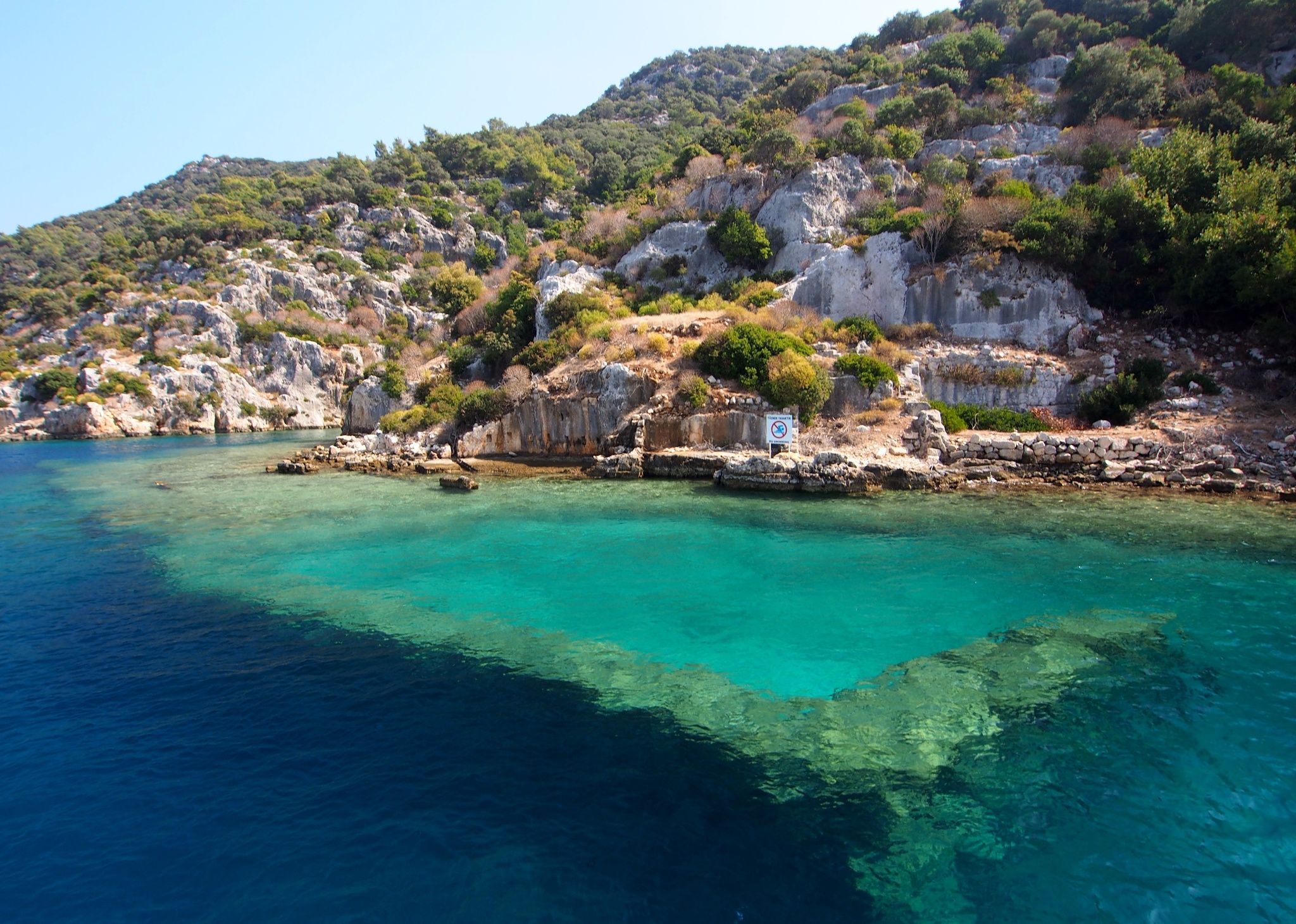
The Kekova sunken city is one of the few places in the Mediterranean where you can float above ancient streets and look down at stone staircases disappearing into clear water. It sits on the quiet Lycian coast between Kaş and Demre, and the best way to reach it is the way people always have: by sea.
A gulet cruise from Fethiye turns Kekova into the highlight of a week on the water rather than a rushed day trip. Along the way you pass Ölüdeniz, Butterfly Valley, Kalkan and Kaş, anchoring in bays that day boats leave behind by late afternoon.
The short answer: the Kekova sunken city is the partly submerged ruin of an ancient settlement on the north shore of Kekova Island, flooded by earthquakes in the 2nd century AD. It is a protected site, so swimming, diving and anchoring over the ruins are not allowed; you view them from a boat or kayak. A gulet cruise from Fethiye to Kekova takes around one week.
What is the Kekova sunken city?
In antiquity the town was known as Dolichiste. Powerful 2nd-century earthquakes dropped part of it below sea level. The settlement recovered and was busy again in Byzantine times, before being abandoned after Arab raids.
Today, as your boat glides along the shore, you can make out foundations, steps cut into the rock, old moorings and fragments of amphorae a few metres down. Some walls stand half in the sea and half on land, which makes the scene strangely domestic. The wider Kekova region was declared a Specially Protected Area in 1990, and Kekova has been on UNESCO’s World Heritage Tentative List since 2000.
Can you swim at the Kekova sunken city?
No. Swimming, diving and anchoring are prohibited over and around the sunken city ruins. Swimming is allowed elsewhere in the Kekova area, but the ruins themselves remain off limits. Boats may approach only to a set distance, and you enjoy the view from the deck.
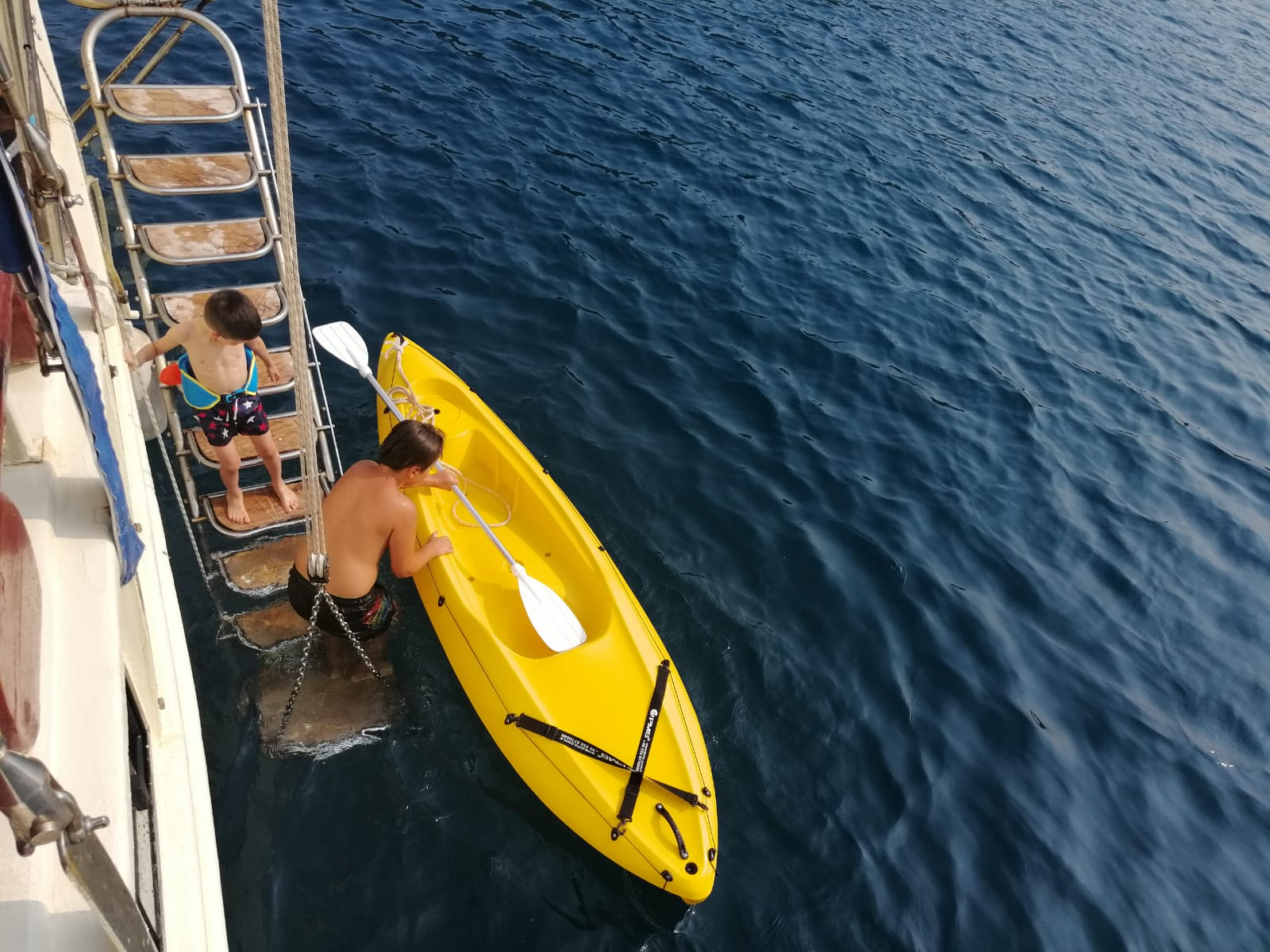
Kayaking past the ruins is permitted, and it is a lovely, silent way to see them. You may read reports about plans for controlled diving at selected points, but treat these as proposals rather than an open invitation. Rules can change, so check the current situation before you travel; our captain always follows the local authorities on the day.
Best time of day
Go early. In the morning the sea is usually flat and the light falls straight into the water, so the ruins look sharpest. Day boats from Kaş and Üçağız build up towards midday. Polarised sunglasses help a great deal by cutting the glare on the surface.
Simena and Kaleköy: a castle above the sea
Facing Kekova Island, the hamlet of Kaleköy stands on the site of ancient Simena. There is no road in: you arrive by boat or on foot, and vehicles are banned. That isolation is exactly why it feels so unspoilt.
The castle on the hilltop dates from the Middle Ages. Inside its walls is a tiny rock-cut theatre that held around 300 people, often called the smallest in Lycia. Down by the harbour, a Lycian sarcophagus sits half-submerged in the water, the most photographed sight in the whole area.
- What to do: climb to the castle for the view over Kekova Island, wander the lanes, stop for a drink by the water.
- Best time: late afternoon, when the heat eases and the light turns golden.
- Good to know: archaeological sites may charge an entrance fee, which guests pay locally.
Üçağız (Teimiussa): tombs by the water
About a kilometre from Kaleköy, Üçağız is a fishing village on a sheltered inlet. Its ancient name was Teimiussa, and it served as a harbour for the inland cities of Kyaneai and Myra.
On the eastern edge of the village lies a necropolis with well-preserved sarcophagi and rock-cut tombs carrying Lycian inscriptions. Like its neighbours, parts of Teimiussa slipped under the sea in earthquakes. The calm water makes Üçağız a favourite overnight stop.
- What to do: a short walk among the tombs, fresh fish in the village, an evening stroll along the quay.
- Best time: early morning or early evening; the stones get very hot at noon.
Tersane Bay: swimming beside the ruins
On the north-west of Kekova Island, Tersane Bay was the site of ancient Xera and an old dockyard, hence the name, which means “shipyard” in Turkish. The ruins of a Byzantine church still stand on the shore.
It is one of the few spots near the sunken city where boats can stop, and you can swim here among submerged stonework. The shore is rocky, so bring water shoes.
Aperlai: a half-sunken Lycian port
West of Kekova, on the Sıçak Peninsula, lie the remains of Aperlai. There is no road; you come by boat or along a marked trail of roughly 7 km on the Lycian Way. Around 15,000 square metres of the old town now lie underwater.
In the shallows you can trace the drowned quay and parts of the city walls. Aperlai once led a small league of local towns, including Simena, and some sources link it to the precious purple-dye trade. It sits inside the protected area, so let the captain advise where you can get in the water.
Gökkaya Bay: cool water and a sheltered anchorage
Gökkaya is the largest of the sheltered inlets around Üçağız, opposite Aşırlı Island. Protected from the wind, it is a classic place to anchor for the afternoon. Freshwater springs rising from the seabed keep the water a touch cooler than the open sea.
Much of the bay is just a few metres deep, which is ideal for swimming, paddleboarding and kayaking.
Stops on the way from Fethiye
Ölüdeniz and Butterfly Valley
Ölüdeniz, the famous Blue Lagoon, is known for its calm turquoise water and for Babadağ, whose launch sites at over 1,900 m make it one of the world’s great paragliding spots.
Next door, Butterfly Valley has been a first-degree nature reserve since 1995. More than 100 butterfly species have been recorded there, the Jersey tiger being the best known, and a short path leads to small waterfalls that flow all year. Midsummer is the peak time for butterflies.
Gemiler Island
Also called St Nicholas Island, Gemiler is scattered with Early Christian and Byzantine church ruins. Going ashore requires a ticket. Climbing to the top for sunset is one of the great rituals of a blue cruise.
Kalkan and Kaş
Kalkan is a former Greek fishing village with whitewashed 19th-century houses tumbling down to its harbour. Kaş is livelier, with a bustling harbour and the Antiphellos theatre, built in the 1st century BC and able to seat around 4,000. If you would rather focus on these two towns, see our Fethiye to Kaş and Kalkan cruise.
Planning your Fethiye to Kekova gulet cruise
When to go
Our season runs from April to November. June to September brings the warmest sea; late September and October offer quieter bays and softer weather. Trips outside the season can be arranged on request.
How long it takes
The Fethiye to Kekova route takes around one week. Exact stops are agreed with the captain depending on wind and sea conditions. Full details are on our Fethiye to Kekova blue cruise page.
A typical day aboard
- Wake up in a quiet bay, breakfast on deck and a first swim.
- A morning sail, perhaps gliding past the sunken city while the light is good.
- Lunch at anchor, then kayaking, paddleboarding or snorkelling.
- A late-afternoon walk to a castle or village, then dinner aboard.
The gulet and what is included
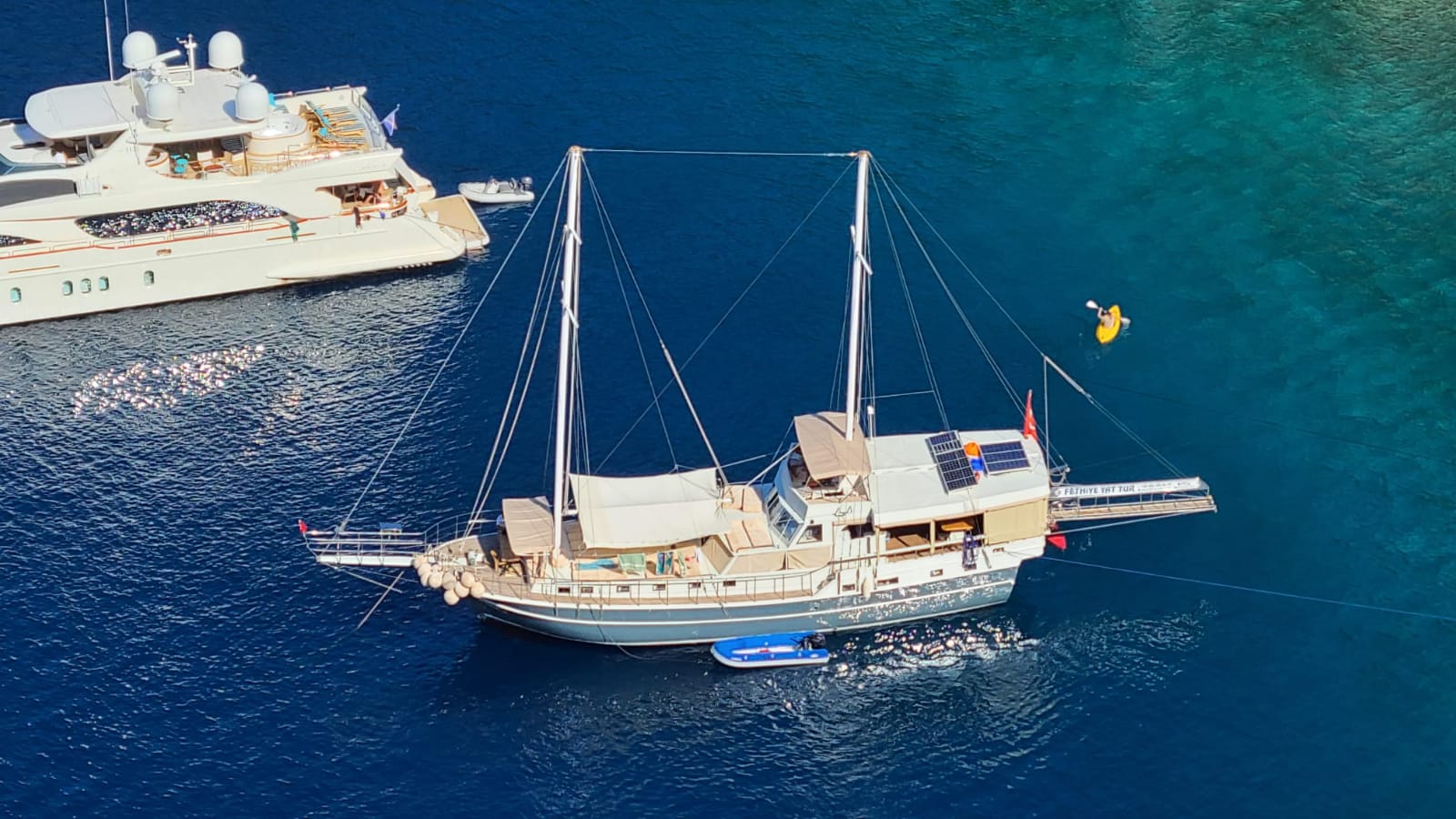
Our gulet is 22.5 m long with 8 cabins, each with its own shower and WC, and takes up to 16 guests. The captain and crew are family. Prices include the captain and crew, fuel, up to two port fees (embarkation and disembarkation), passenger and boat insurance, bed linen and towels, free bays along the Turkish coast, and kayaks, SUP boards, fins, snorkels and pool noodles.
Not included: airport transfers, paid bays, marinas, national park and site entrances, and personal expenses. You can learn more about the gulet on its own page.
Meals: private charter or cabin charter
- Private charter: the crew cooks every meal. We can buy the provisions, or you are welcome to bring your own food and drink.
- Cabin charter: we buy the food and the crew cooks. Drinks are sold on board, and outside drinks cannot be brought.
Getting there
The nearest airport is Dalaman, about 45 minutes from Fethiye. You board at Fethiye Yacht Harbour in Karagözler. Transfers can be priced in advance if you need one.
Prices and booking
We do not publish prices online. Instead, we prepare a quote based on your dates, group size, route and charter type. For a Kekova boat trip by gulet, send your dates by WhatsApp or phone on +90 506 389 49 10, or use our contact page.
Frequently asked questions
Can you swim at the Kekova sunken city?
No. Swimming, diving and anchoring are prohibited over the sunken city ruins. You view them from a boat or kayak, and you can swim at nearby spots such as Tersane Bay.
Why is Kekova a sunken city?
Earthquakes in the 2nd century AD dropped part of the ancient town on Kekova Island below sea level. It was later reused in Byzantine times before being abandoned.
How do you get to Kekova from Fethiye?
Day trips usually leave from Kaş or Üçağız. From Fethiye, a gulet cruise to Kekova takes around one week, with stops along the Lycian coast.
Is Simena worth visiting?
Yes. Simena, the village of Kaleköy, has a medieval castle, a tiny rock-cut theatre and a half-submerged Lycian tomb, and it can only be reached by boat or on foot.
What is the best time for a Kekova boat trip?
June to September for warm water, or late September and October for quieter bays. Mornings give the clearest view of the ruins.